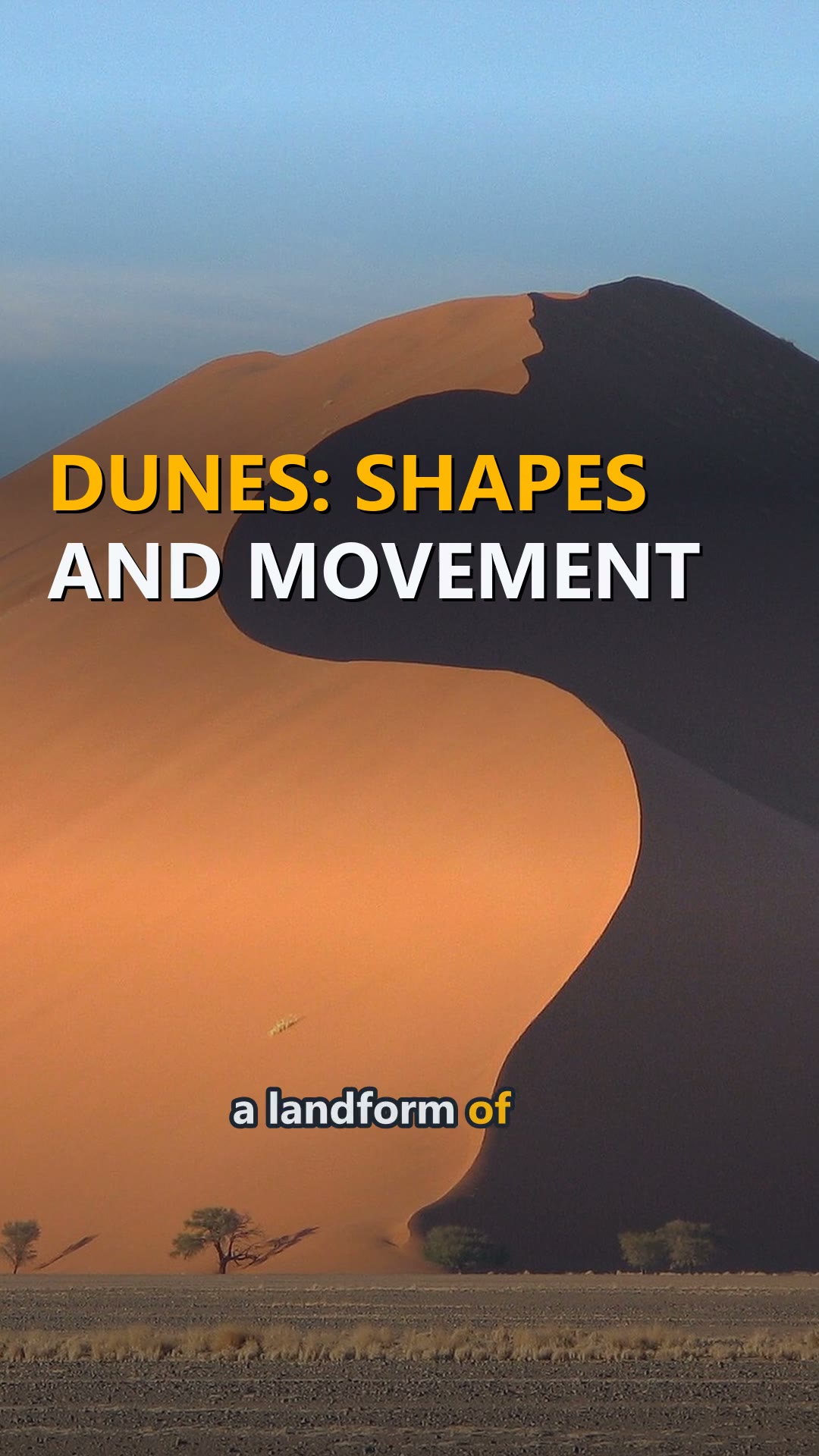
Dunes: Shapes and Movement
A dune is a landform of wind- or water-driven sand. Dunes can form mounds, ridges, or hills in sand fields. Dune systems with many dunes are called dune fields.
What the video says
A dune is a landform of wind- or water-driven sand.
Dunes can form mounds, ridges, or hills in sand fields.
Dune systems with many dunes are called dune fields.
Dunes grow taller than 7 cm, distinguishing them from ripples.
Sand creeps or bounces up the stoss side of dunes.
The lee side has a slip face where sand slides down.
Barchan dunes are crescent-shaped with tips pointing downwind.
Seif dunes are long, sharp-crested, and can reach 300 meters.
Star dunes have multiple arms radiating from a high center.
Parabolic dunes are U-shaped, with arms held by vegetation.
Reversing dunes have slip faces oriented in opposite directions.
Draas are very large dunes, tens to hundreds of meters tall.
Coastal dunes protect land from storm waves and flooding.
Dune slacks are valleys between dunes, often moist and flat.
Dune shapes show wind direction and sand supply dynamics.
Source
More to watch
More from WorldAll phenomena videos
- The tongue map is a myth: every part tastes everything
- Do we use only 10% of our brain? Myth, debunked
- Is the Bermuda Triangle dangerous? NOAA says no
- Vikings did not wear horned helmets
- The asteroid belt is mostly empty space
- The Sun is not yellow, it is white
- Venus, not Mercury, is the hottest planet
- Brinicle Explained