Sudbury Basin: Massive Impact, Hidden History
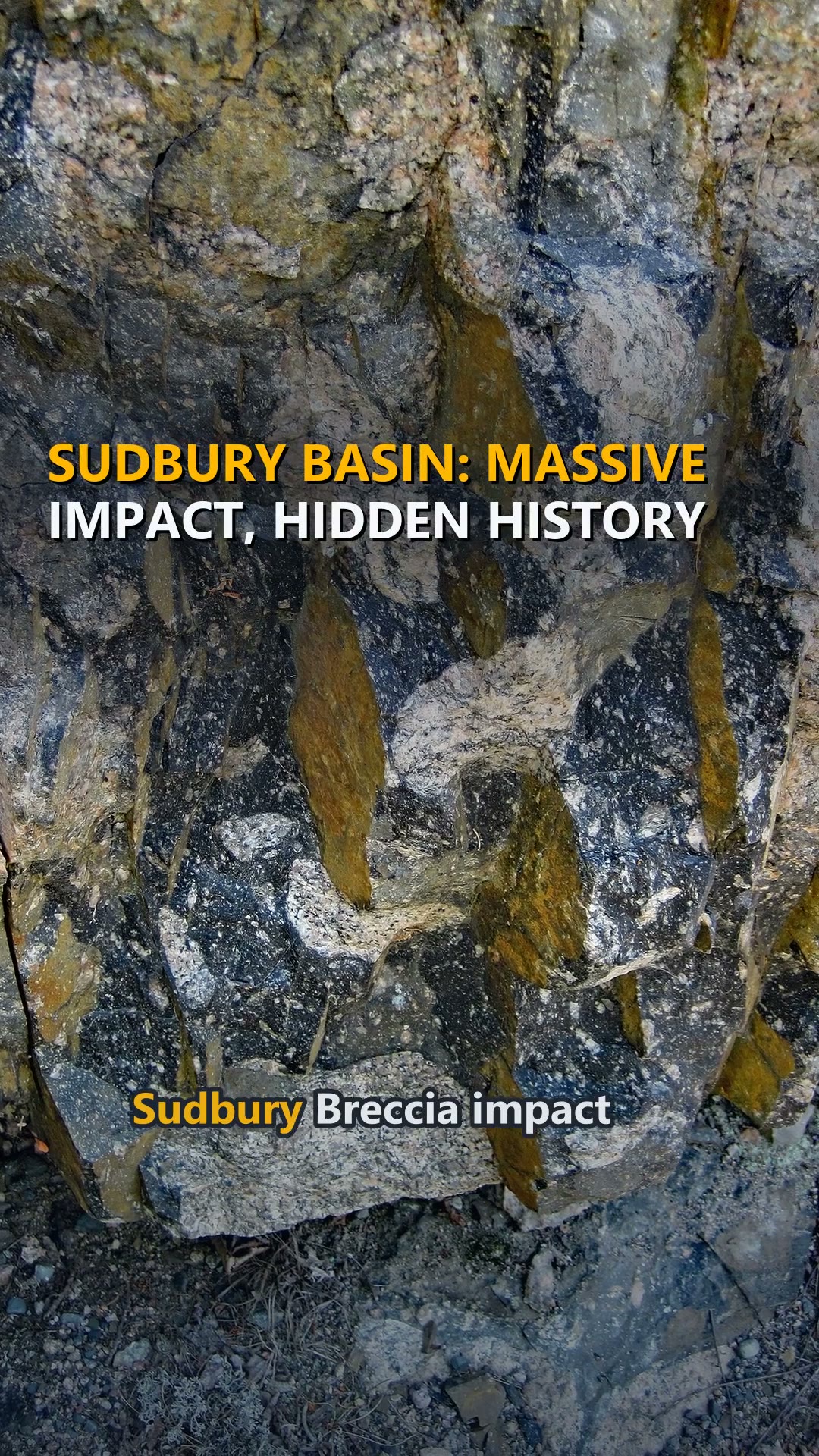
Rock outcrop with Sudbury Breccia impact pseudotachylite. Pentlandite and pyrrhotite minerals form in Sudbury Basin. 849 billion years ago.
What the video says
Rock outcrop with Sudbury Breccia impact pseudotachylite.
Pentlandite and pyrrhotite minerals form in Sudbury Basin.
An asteroid 10 to 15 kilometres wide struck 1.849 billion years ago.
Rock fragments ejected by the Sudbury impact crater.
Black impact breccia rock from Sudbury Impact Structure.
Sudbury Basin is now 62 kilometres long and 30 kilometres wide.
Original crater measured roughly 130 kilometres across before erosion.
Erosion removed about 6 kilometres of rock in the North Range.
Metal ores of nickel, copper, gold, and platinum group fill rims.
Mining began after 1856 due to magnetic anomalies discovered here.
Ore minerals include pyrrhotite, chalcopyrite, pentlandite, and bornite.
NASA trained Apollo astronauts here to recognize impact rock types.
The Sudbury Igneous Complex formed right after the meteor impact event.
Impact breccia intrudes granite in Sudbury Basin rocks.
Rock outcrop showing Sudbury Breccia impact pseudotachylite.
Source
More to watch
More about CanadaMore from WorldAll phenomena videos
- Confederation Bridge is longest over ice-covered water
- Rocky Mountaineer changed luxury train travel
- The tongue map is a myth: every part tastes everything
- Do we use only 10% of our brain? Myth, debunked
- Is the Bermuda Triangle dangerous? NOAA says no
- Vikings did not wear horned helmets
- Joggins Fossil Cliffs: Earth’s Coal Age Time Capsule
- Manicouagan Reservoir is a 214-Million-Year-Old Impact Crater