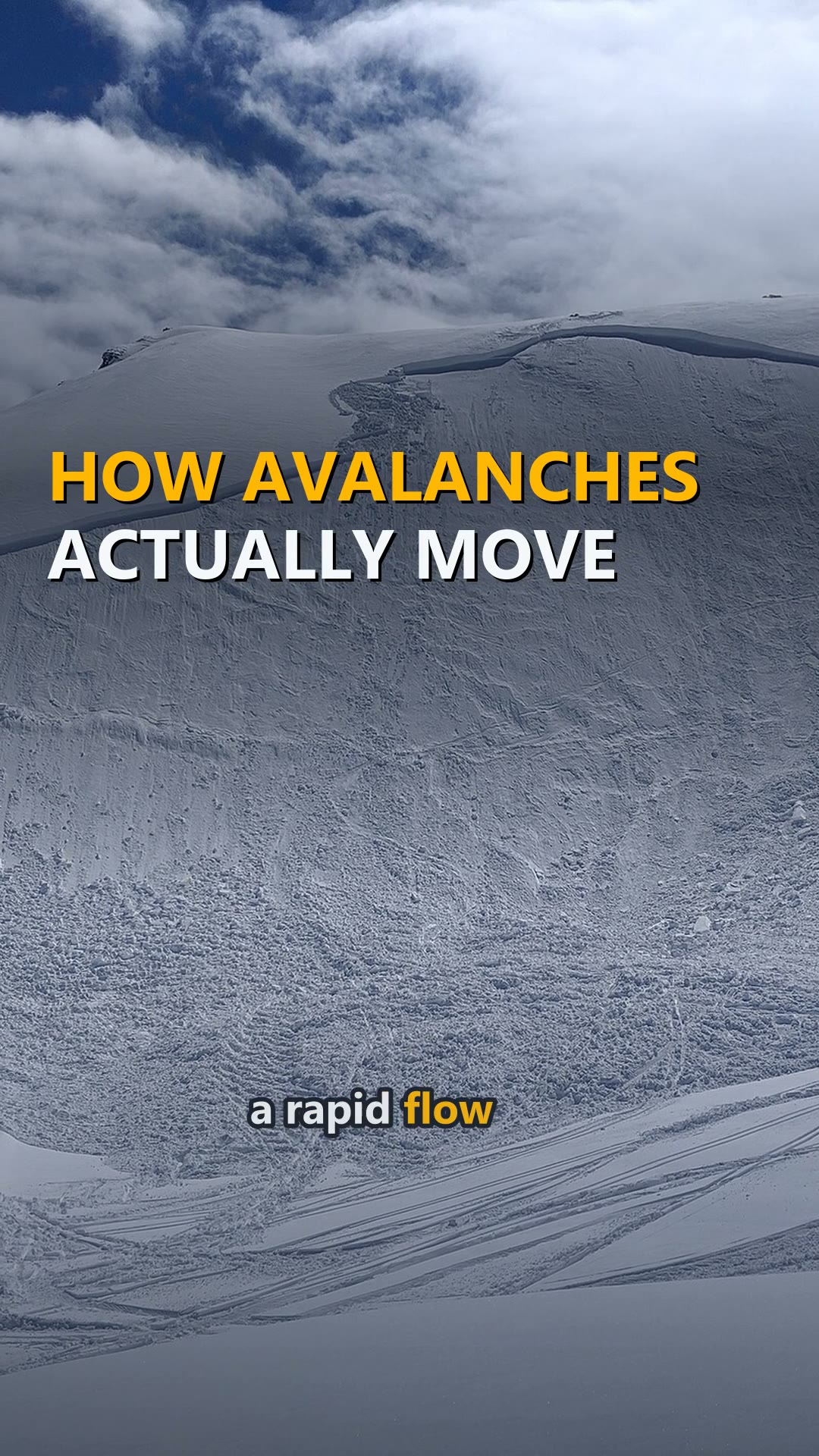
How Avalanches Actually Move
An avalanche is a rapid flow of snow down a slope. They happen in any mountain range with an enduring snowpack. Slab avalanches form when stiff snow collapses over a weak layer, releasing thousands of cubic metres.
What the video says
An avalanche is a rapid flow of snow down a slope. They happen in any mountain range with an enduring snowpack.
Slab avalanches form when stiff snow collapses over a weak layer, releasing thousands of cubic metres. Like dropping a concrete ceiling made of snow.
Powder snow avalanches are turbulent suspension currents exceeding speeds of 300 km/h carrying 1,000,000 tons. A million tons makes for a stiff breeze.
Wet snow avalanches travel much slower, around 10 to 40 km/h generating powerful destructive forces.
They briefly travel uphill on flat ground.
Contrary to popular belief, loud sound cannot trigger an avalanche. The pressure is too small. Yelling remains pointless.
A slab disintegrates into smaller fragments as it travels downhill. Fine particles become airborne above the surface.
Professor Lagotala modeled avalanches for the 1924 Winter Olympics. Voellmy later developed his method further.