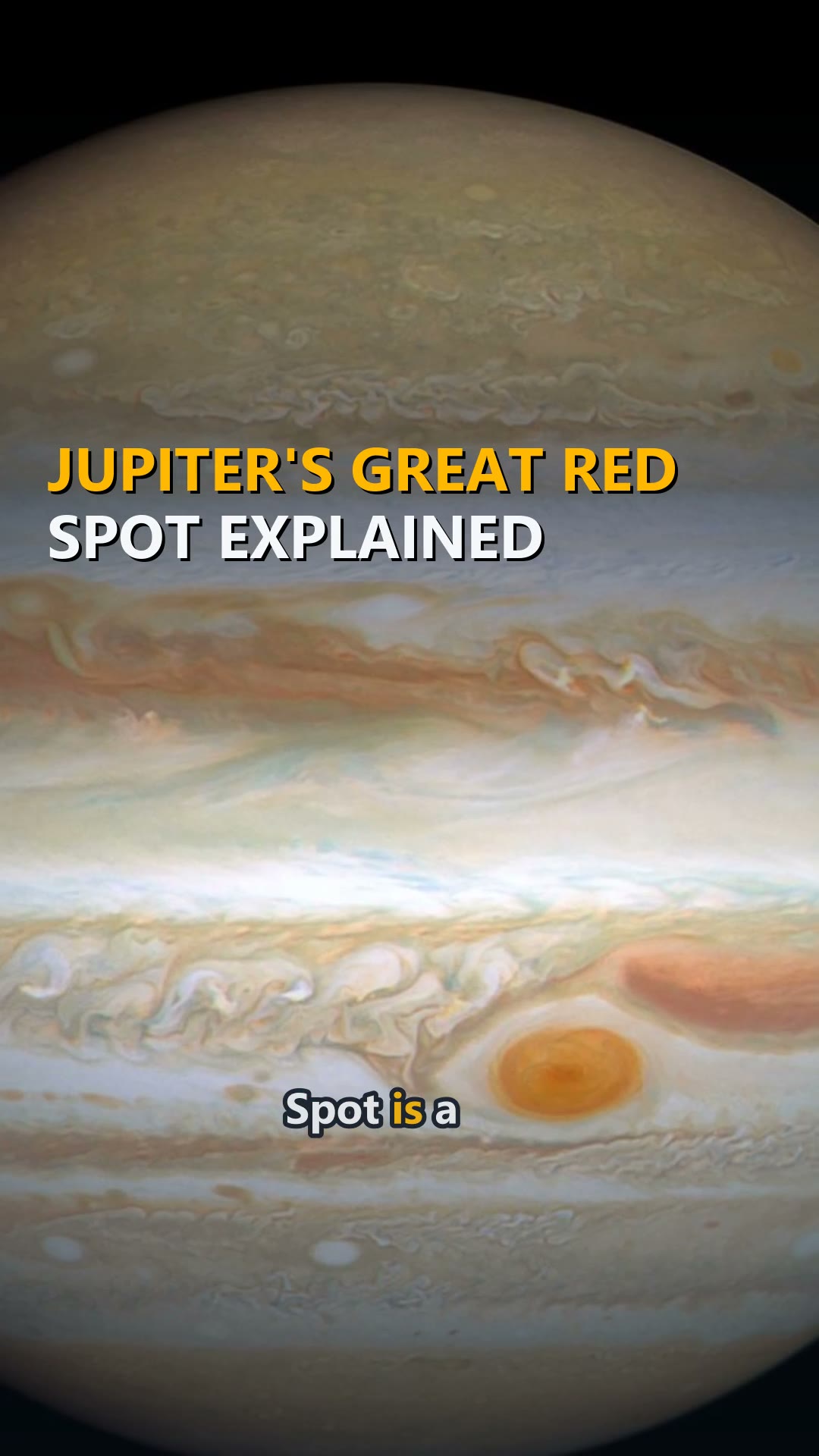
Jupiter's Great Red Spot Explained
The Great Red Spot is a persistent high-pressure region in Jupiter's atmosphere. Its red-orange color comes from solar radiation. Continuous observations began in 1879 after sixty recorded sightings.
What the video says
The Great Red Spot is a persistent high-pressure region in Jupiter's atmosphere. Its red-orange color comes from solar radiation.
Continuous observations began in 1879 after sixty recorded sightings. A 2024 study suggests earlier spots were different storms.
On 25 February 1979, Voyager 1 transmitted an image from 9,200,000 km away. Cloud details as small as 160 km appeared.
Juno flew over the Great Red Spot on 11 July 2017. A shallow puddle by Jupiter standards.
A persistent spot was observed during those years.
The Great Red Spot rotates counterclockwise every 4.5 Earth days. Winds around the edge peak at 432 km/h.
Measuring 16,350 km wide on 3 April 2017, it has shrunk for a century. It may become circular by 2040.
The storm continues because Jupiter has no surface to cause friction. Nothing like hydrogen to avoid friction.