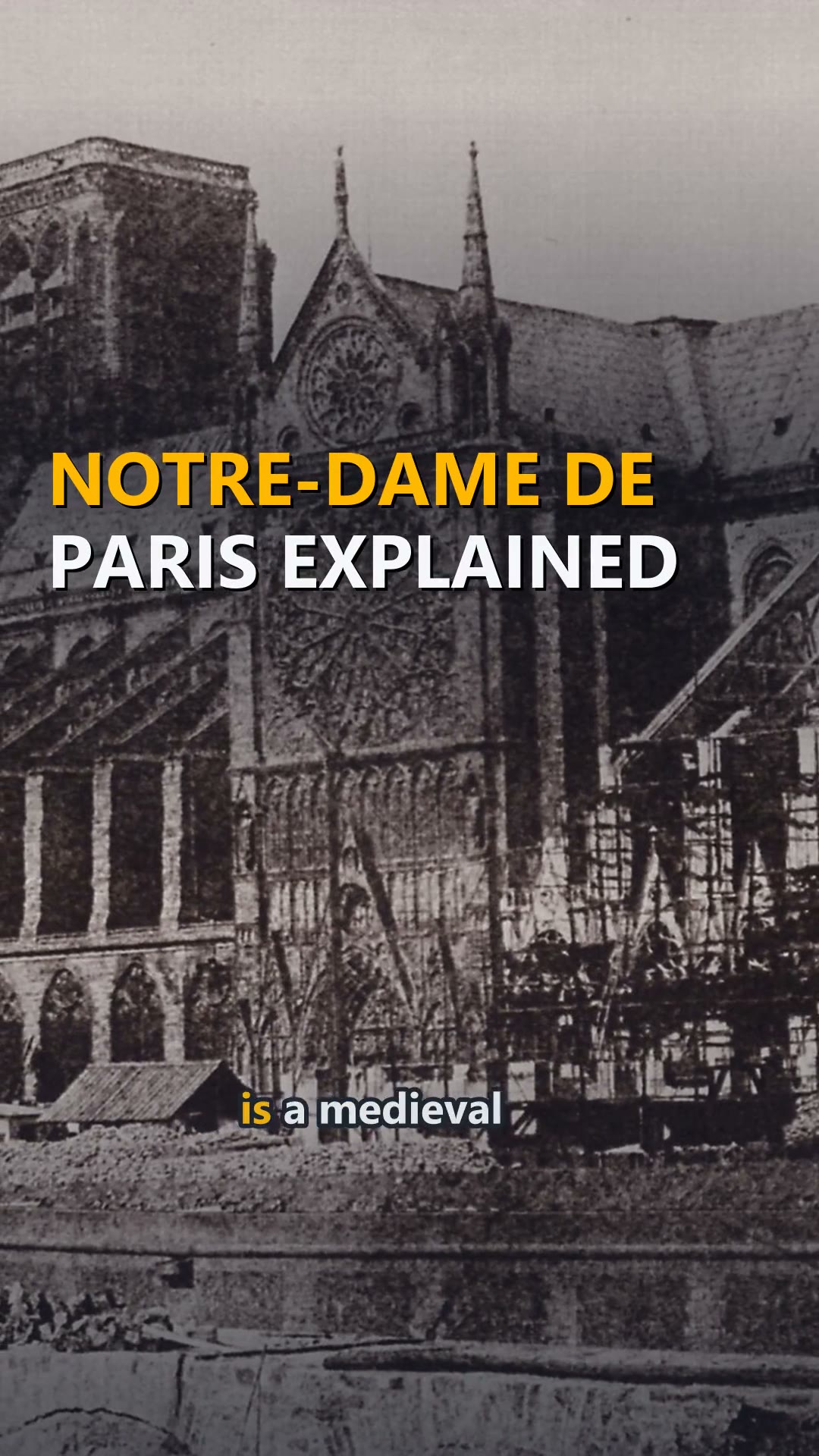
Notre-Dame de Paris Explained
Notre-Dame de Paris is a medieval Catholic cathedral on the Île de la Cité in France. Construction began in 1163. Flying buttresses carry the roof weight outside the walls to stone counter-supports.
What the video says
Notre-Dame de Paris is a medieval Catholic cathedral on the Île de la Cité in France. Construction began in 1163.
Flying buttresses carry the roof weight outside the walls to stone counter-supports. The walls get to be thin.
The north transept has a rose window added by Jean de Chelles in the late 1240s. The cathedral holds three pipe organs.
During the French Revolution, bronze, lead, and precious metals were melted down. Bronze bells make terrible employees anyway.
Victor Hugo published Notre-Dame de Paris in 1831. Restoration ran from 1844 to 1864 under Eugène Viollet-le-Duc.
It welcomed more visitors each year than any other Paris monument.
A fire in April 2019 destroyed a large part of the roof. Reconstruction lasted 3 years. It reopened in December 2024.
Source
More to watch
More about FranceMore from WorldAll places videos
- Mont-Saint-Michel's Timeless Island
- Mont Blanc: Europe's Alpine Giant
- He dug up Ramses II in his garden, then called the authorities
- Fiordland’s Vast Wild Landscape
- Codex Gigas weighs 74.8 kilograms
- The robot wrote his report in four seconds. Brian had a plan
- The Tour de France Explained
- Le crêt de la Neige, toit du Jura