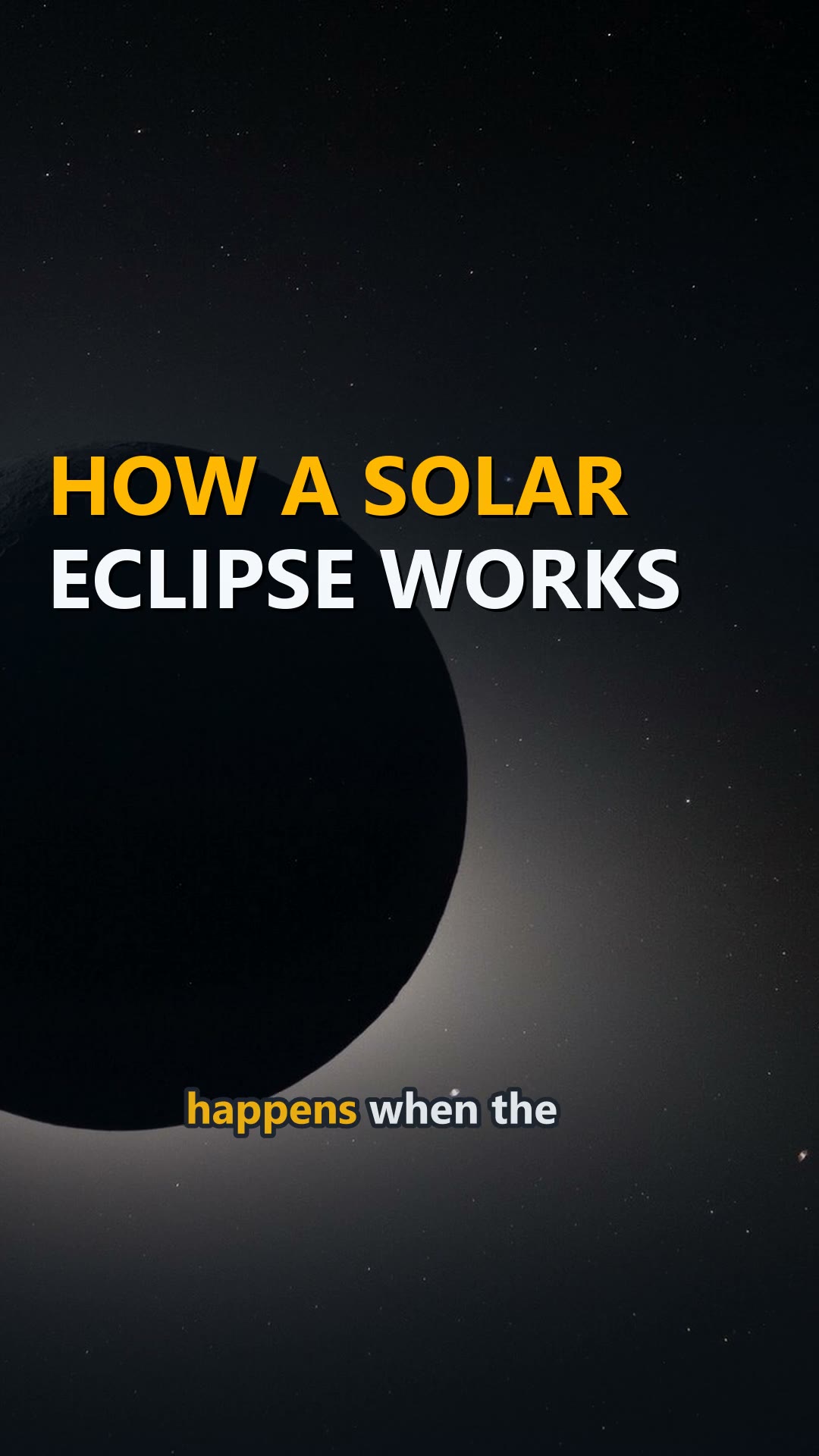
How a Solar Eclipse Works
A solar eclipse happens when the Moon passes between Earth and the Sun, blocking its light from a small part of Earth. The Moon orbits at an angle of 5 degrees to Earth, so its shadow usually misses us entirely. The umbra's width is narrow compared to the penumbra.
What the video says
A solar eclipse happens when the Moon passes between Earth and the Sun, blocking its light from a small part of Earth.
The Moon orbits at an angle of 5 degrees to Earth, so its shadow usually misses us entirely.
The umbra's width is narrow compared to the penumbra.
An annular eclipse leaves a bright ring around the dark disk—the word comes from Latin anulus, meaning ring.
A partial eclipse barely dims a desk lamp.
Looking directly at the Sun causes permanent eye damage. Special protection is required outside the total phase.
Umbraphiles have very specific vacation priorities.
The Sun is 400 times wider than the Moon but also 400 times farther away—geometry puts on a good show.